China’s Digital Instrument Panel industry has developed rapidly across vehicles, industrial equipment, agricultural machinery, and smart mobility. This guide examines ten manufacturers with visible capabilities in design, engineering, production, and after-sales support. It considers more than product appearance. Display brightness, operating temperature, CAN communication, touch response, enclosure quality, and software compatibility also matter.
The evaluation focuses on practical evidence, including manufacturing experience, certification awareness, customization capacity, and customer service. A strong supplier should explain its testing process clearly. It should also provide samples, technical drawings, and realistic delivery information. Some companies may excel in automotive dashboards, while others specialize in compact panels for construction equipment or electric vehicles. No ranking is permanently objective. Buyer requirements can change the result.
Details matter. A readable panel under direct sunlight may outperform a cheaper model with better-looking specifications. Stable performance at low temperatures is equally important for outdoor machinery. We also consider whether manufacturers can support small design changes, such as warning icons, connector layouts, or multilingual interfaces. These points often reveal real engineering capability.
Still, public information is not always complete. Supplier claims require verification through samples, factory audits, and reference checks. This article offers a structured starting point, not a final purchasing decision. Use it to compare strengths carefully and identify the manufacturers most suitable for your application.
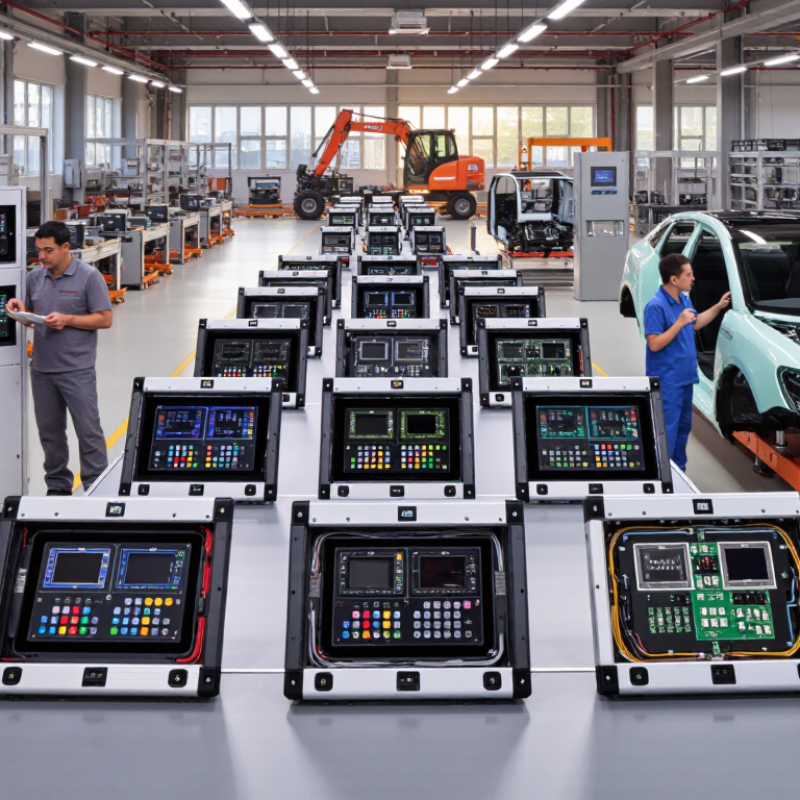
China’s digital instrument panel industry is expanding with the wider vehicle market. According to the China Association of Automobile Manufacturers, China produced 31.28 million vehicles in 2024. Sales reached 31.44 million units. New-energy vehicle production exceeded 12.88 million units. These volumes support demand for configurable clusters, high-resolution displays, and integrated cockpit electronics.
Manufacturers compete through optical performance, embedded software, supply stability, and validation discipline. Panels must remain readable under direct sunlight and stable below freezing. Engineers also test vibration, electromagnetic compatibility, thermal cycling, and cybersecurity controls. Omdia’s automotive display research identifies China as a major production and demand center. Still, “largest” needs careful definition. Assembly capacity, domestic shipments, and export value measure different realities.
A reliable supplier assessment should examine ISO 26262 processes, IATF 16949 systems, pixel failure policies, repair rates, and production traceability. Software update capability matters too. Screen size alone proves little. CAAM vehicle statistics indicate market demand, but they do not directly measure instrument-panel shipments. More panel-specific data remains necessary. This is an important limitation. Buyers should request audited figures, environmental test results, and sample validation records before ranking manufacturers.
Chinese digital instrument panel manufacturers are competing through display quality, computing power, and vehicle integration. When comparing the top ten suppliers, engineers often inspect performance under heat, vibration, and direct sunlight. TFT-LCD remains widely used because it offers stable brightness and controlled costs. AMOLED provides deeper blacks and sharper contrast. However, heat management can become difficult. Optical bonding removes the air gap between glass layers, reducing reflections and improving touch accuracy.
Modern panels rely on automotive-grade microcontrollers or system-on-chip platforms. These processors manage graphics, warning icons, navigation data, and real-time vehicle signals. CAN and CAN FD support dependable communication with electronic control units. Automotive Ethernet enables faster data transfer for high-resolution maps and camera views. Secure boot, encrypted communication, and controlled software updates help reduce unauthorized access. Functional safety design is also essential when the display carries speed or warning information.
Ambient light sensors adjust brightness within seconds. Haptic feedback can make touch controls easier to recognize without looking away from the road. Engineers also test cold starts, screen aging, connector failures, and electromagnetic interference. Factory experience shows that software stability often matters more than visual effects. A beautiful interface is not enough. Some panels still suffer from delayed animations or confusing alerts, especially after software revisions. That weakness deserves honest testing, not promotional language. Human-machine interface design remains partly subjective, so driver feedback should influence final calibration.
China’s digital instrument panel sector is expanding with vehicle production and software integration. The China Association of Automobile Manufacturers reported 31.28 million vehicles produced in 2024. New-energy vehicles represented a significant share of that output. The International Energy Agency also stated that China accounted for more than half of global electric car sales in 2023. This demand supports wider use of high-resolution displays, integrated driving information, and over-the-air software functions.
A practical review of the top 10 digital instrument panel manufacturers in China should examine display clarity, processor performance, cybersecurity controls, production capacity, and long-term supply stability. Deloitte’s 2024 China Automotive Consumer Survey shows that connected features increasingly influence vehicle purchasing decisions. However, screen size alone proves little. A reliable panel must remain readable in direct sunlight, cold weather, and heavy vibration. It also needs fast startup and accurate warning graphics. Small delays can reduce driver confidence.
The ranking should combine verified delivery records, certification evidence, engineering experience, and customer support capability. Public information is sometimes incomplete. That limitation matters. Some manufacturers report strong technical specifications but offer limited field data. Buyers should request sample testing, failure-rate records, and software update policies before selecting a supplier. Better judgment comes from measurable performance, not attractive demonstrations. The strongest candidates usually balance visual quality, thermal control, interface design, and consistent manufacturing. Fancy screens are not enough.
Evaluating digital instrument panel manufacturers requires more than comparing factory photos or low quotations. Start with the panel’s working environment: voltage range, vibration, moisture, glare, and operating temperature. Ask for measured test results, not general claims. A reliable supplier should explain display brightness in daylight, viewing angles, touch response, and warning visibility. Small details matter. Request samples with the intended controller, sensors, and communication protocol. A panel that works alone may fail inside the vehicle or machine.
Review engineering evidence before discussing production volume. Check drawings, wiring diagrams, firmware revision records, and change-control procedures. Ask how the manufacturer verifies CAN, RS-485, Ethernet, or other required interfaces. Factory acceptance tests should include start-up cycles, connector retention, water resistance, and vibration exposure. I would also inspect calibration records and traceability for critical components. These documents reveal process maturity better than polished presentations. Still, paperwork can look complete while testing remains shallow. Witnessing a sample test is safer than trusting a spreadsheet.
Evaluate the people behind the product. A dependable team can explain failure modes, repair routes, spare-panel planning, and software support after delivery. Confirm response times with a realistic service question, not only a sales inquiry. Review pilot-batch consistency by measuring several units, including brightness, bezel fit, and boot time. Calculate total cost with tooling, validation, packaging, updates, and field replacements. The cheapest quote may become expensive after installation. I would keep a written scorecard and record unanswered questions. My assessment can be imperfect when factory data is limited. That limitation should influence the purchasing decision.
Applications and Future Trends of Digital Instrument Panels
Digital instrument panels are moving beyond speed and fuel displays. They now combine navigation, driver alerts, energy data, and vehicle settings on one screen. In electric vehicles, the panel can show battery temperature, charging range, and regenerative braking in real time. Commercial fleets use larger displays to track driving hours, faults, and maintenance warnings. These applications reduce visual searching, but poor screen design can still distract drivers.
According to MarketsandMarkets’ 2024 Automotive Digital Cockpit Market report, the sector may grow from about USD 22.4 billion in 2023 to USD 36.9 billion by 2028. That represents an estimated compound annual growth rate of 10.5%. The report links growth to connected vehicles, advanced displays, and increasing demand for integrated vehicle information. Meanwhile, UNECE Regulation No. 121 continues to influence how telltales and controls are presented. Compliance is not optional.
Future panels will rely more on augmented reality, voice interaction, and predictive warnings. A windshield display may place a turn arrow directly above a real road lane. Artificial intelligence could detect driver fatigue through steering behavior and eye movement. Yet these systems require careful validation. False warnings may create distrust, while excessive animations can increase workload. This is where manufacturers still need more humility. A brighter display is not automatically a safer one. In practice, readable typography, stable menus, and fail-safe alerts often matter more than novelty.
Global electric car sales are used as an industry-level demand indicator for digital instrument panels. As electrification expands, vehicle displays increasingly support speed, battery state of charge, energy consumption, navigation, driver assistance and connected services.
Large-format digital clusters integrate vehicle status, navigation, media and advanced driver-assistance information.
Fleet operators increasingly require displays for operating efficiency, safety alerts, route information and battery monitoring.
Projected growth is centered on connected cockpits, augmented-reality visualization, personalization and software-defined vehicles.
Source: International Energy Agency, Global EV Outlook 2025. Figures represent global electric car sales, rounded to the nearest million units.
China produced 31.28 million vehicles in 2024. New-energy vehicle production exceeded 12.88 million units. This creates strong demand for configurable displays and integrated cockpit electronics. Demand is clear, but panel-specific shipment data remains limited.
TFT-LCD remains popular because it offers stable brightness and controlled costs. AMOLED delivers deeper blacks and stronger contrast. Optical bonding reduces reflections and improves touch accuracy. Each option involves trade-offs.
CAN and CAN FD support dependable vehicle communication. Automotive Ethernet transfers high-resolution maps and camera views faster. Processors manage warning icons, navigation data, and real-time signals. Integration quality matters more than specifications alone.
Buyers should review automotive quality systems, functional safety processes, traceability, and repair rates. They should request audited delivery figures and environmental test results. Sample validation records can reveal weaknesses hidden by demonstrations.
Panels should remain readable in direct sunlight and stable below freezing. Engineers test vibration, electromagnetic interference, thermal cycling, cold starts, and screen aging. Connector failures also deserve attention. Real conditions are harsh.
Not necessarily. Screen size proves little without fast startup, accurate warnings, and stable brightness. A large display can still suffer from delayed animations. Bigger is not always better.
Controlled software updates can improve functions and address discovered weaknesses. Secure boot and encrypted communication help protect system integrity. Updates may also introduce confusing alerts or delays. Testing after revisions is essential.
Public information may be incomplete, especially for field failure rates and long-term support. Some technical claims lack independent evidence. Buyers should compare measurable results, not attractive interfaces. I would remain cautious.
Clear warning graphics and readable layouts help drivers understand information quickly. Haptic feedback may reduce the need to look away. Driver feedback should influence final calibration. Interface quality is partly subjective.
China’s digital instrument panel manufacturing industry has developed into a highly competitive and innovative sector, supported by strong capabilities in electronics, display technology, embedded systems, and intelligent vehicle components. This article presents an overview of the industry and explains the key technologies used in modern Digital Instrument Panel products, including high-resolution displays, integrated control units, touch interfaces, connectivity functions, and advanced software systems. It also introduces ten representative manufacturers in China without focusing on brand promotion, highlighting their production capabilities, research strengths, customization services, quality management, and international supply experience.
In addition, the article provides practical criteria for evaluating Digital Instrument Panel manufacturers, such as technical expertise, manufacturing capacity, testing procedures, delivery reliability, after-sales support, and compliance with customer requirements. It concludes by discussing major applications in vehicles, industrial equipment, commercial transportation, and smart mobility, while examining future trends such as intelligent displays, lightweight designs, greater integration, improved energy efficiency, and more personalized user interfaces.

Dongou